What Actually Breaks as You Scale — And How We’ve Helped CTOs Fix It
Top 5 Challenges Growth-Stage CTOs Face and How to Overcome Them
Scaling a product organization looks impressive from the outside. Your customer base is expanding. Revenue is climbing. Funding rounds are closing. Headcount is growing. From a distance, it looks like you’re living the dream. From the inside, it often feels like chaos.


Product direction becomes unclear. Higher valuations bring mounting pressure on the product development team to deliver on multiple fronts. Meanwhile, the systems that once made the company fast begin quietly working against it.
Nothing is visibly broken, but everything becomes much harder.
This is the phase where many strong product organizations become inefficient and trust from leadership in the team begins to erode. Not because they lack talent. Not because the strategy is wrong. But because the operating model that enabled early growth was not designed for scale.
Over the past decade, we’ve worked alongside CTOs and CPOs and have been the highest performing team inside some of the fastest-growing technology companies in cybersecurity, fintech, and healthcare. Collectively, these companies have raised over a billion dollars in funding and operate products used by Fortune 500 enterprises, banks, and tens of millions of users worldwide.
Different industries. Different technologies. Different leadership teams.
Yet the underlying operational challenges we see on the ground with each company are remarkably consistent.
Below are the patterns we see again and again. And what separates the organizations that successfully work through them from those that remain stuck.
1. Product direction becomes unclear as the organization grows
Early on, product direction is usually obvious. Founders are close to customers. Feedback loops are short. Decisions happen quickly, and momentum comes naturally.
Then the company grows.
The board becomes larger and more vocal. Executives bring new priorities. Sales pushes for more features. Marketing wants more differentiation. Investors want to see expansion, and fast.
Every product request may feel rational on its own. But without sufficient product or user data, leaders lack the foundation to evaluate them properly. Together, these inputs create drift.
Roadmaps begin shifting constantly. Teams build large initiatives that feel urgent in the moment but fail to move core metrics, often becoming expensive disappointments. Strategy becomes reactive rather than intentional.
Eventually, product leaders find themselves in an uncomfortable position: they are expected to provide direction and clarity without having a stable foundation to stand on.
And when there is no shared evidence, the loudest voice usually wins.
The symptoms appear quickly:
- Features ship but adoption is weak
- Teams struggle to explain why something matters
- Engineering effort spreads thin across competing priorities
- Confidence in the roadmap quietly erodes
We’ve seen this dynamic inside companies operating at scale. And growth only amplifies it.
What actually stabilizes product direction
The only reliable anchor is shared evidence.
Not opinions.
Not hierarchy.
Not the loudest voice.
Evidence.
When product direction becomes unstable, the first step we take with our CTO partners is to re-establish a clear product North Star that leadership, sales, product, and engineering all agree is worth pursuing.
We capture this in a North Star Map which is a simple visual blueprint that connects long-term product vision to the features and capabilities that deliver real user value. It clarifies what matters most, how each part of the product supports the mission, and where to focus investment.
Because the map is grounded in market data, competitive analysis and mystery shopping, and user research, it gives teams the confidence to prioritize, make trade-offs, and move in one direction.
From there, future product decisions become more practical:
- Focused discovery to align stakeholders around real user value
- Direct user research on the product’s highest-impact flows
- End-to-end funnel visibility to understand where value breaks down
The goal is not more research. It is making sure you have better information for better decisions.
When teams can clearly connect roadmap priorities to observable user behavior and measurable outcomes, prioritization becomes defensible. Product leaders gain the ability to push back when necessary and the organization regains strategic stability and focus.At this point, the team stops reacting and starts executing.
2. Delivery becomes unreliable even with strong teams
Most scaling problems are incorrectly blamed on a lack of talent. In reality, they start with a lack of structure.
As organizations grow, old systems stop working.
→ Product defines requirements and scope
→ Design creates the UI/UX
→ Engineering builds
→ QA tests
→ Business reviews
→ Release
Each step can become a bottleneck. Each transition can introduce loss of context. Before long, what gets released differs from what was expected, rework increases, and timelines slip.
Often times we also see that the team topology introduces additional friction. Front-end and back-end may plan separately. Dependencies become harder to coordinate. Releases involve more moving parts. Informal processes that worked at 30 people fail at 100.
Deadlines begin to slip. Not dramatically at first, but just enough to cause concern.
Eventually, missed commitments become expected. Leadership loses confidence, and the product organization develops a reputation for being unreliable.
In most cases, the individuals are capable. The system they operate inside is not.
What restores predictable delivery
Reliability comes from shared ownership and structural clarity. Major transformations are rarely required. Small structural adjustments and disciplined operating habits often create the biggest impact.
The shifts that make the greatest difference are straightforward:
Cross-functional planning and review cadences
- Move away from linear handoffs between product, design, and engineering. Instead, create shared decision moments.
- Joint refinement sessions should bring product, design, and engineering together to challenge scope, surface dependencies, and identify risks before work begins.
- Sprint reviews should function as decision forums, not just demonstrations. The right business stakeholders attend, accept or reject work, and adjust priorities immediately.
- At scale, teams also need a coordinating cadence across initiatives. A regular program-level review ensures all streams are aligned to one roadmap and one set of risks, rather than each team optimizing locally.
Clear acceptance criteria before work begins
- Ambiguity early in the process almost always becomes rework later.
- Define expected outcomes in business terms, not just technical tasks. Ensure product, engineering, and QA agree on acceptance criteria before a ticket is considered ready for development.
- Many organizations benefit from a consistent structure for stories and epics that clarifies the problem being solved, the intended outcome, constraints, and acceptance criteria. This reduces scope creep and prevents late-stage confusion during testing and release.
QA embedded throughout development rather than at the end
- When testing happens only after implementation, problems surface too late to resolve efficiently.
- High-performing teams involve QA during refinement and design so testability and edge cases are defined early. QA operates as part of the delivery squad, participating in planning, standups, and reviews.
- Testing happens continuously as work progresses, not after code is merged. A clear definition of “done” includes validated functionality, not just completed implementation.
A single coordinating layer across teams and dependencies
- As systems grow, coordination becomes a full-time responsibility.
- Someone must own the end-to-end delivery view across front-end, back-end, integrations, and data. This coordinating role maintains one unified plan, tracks dependencies explicitly, and ensures teams are aligned on what must ship, in what order, for a feature to go live.
- Program-level tracking should make scope visible over time and distinguish between work completed and work fully validated. This prevents delivery issues from being misattributed to engineering speed when the real constraint lies elsewhere.
Structured UAT with defined ownership and rapid feedback
- UAT (User Acceptance Testing) should be a planned phase with clear ownership, not an informal final step.
- Business stakeholders responsible for validation should be identified early, with dedicated time allocated for testing and sign-off.
- UAT should confirm that agreed requirements and workflows are met. New ideas and major changes are captured for future iterations rather than extending the validation cycle indefinitely.
- Simple tracking of test coverage, execution progress, and resolution timelines keeps feedback fast and release decisions clear.
A single coordinating layer across teams and dependencies
- As systems grow, coordination becomes a full-time responsibility.
- Someone must own the end-to-end delivery view across front-end, back-end, integrations, and data. This coordinating role maintains one unified plan, tracks dependencies explicitly, and ensures teams are aligned on what must ship, in what order, for a feature to go live.
- Program-level tracking should make scope visible over time and distinguish between work completed and work fully validated. This prevents delivery issues from being misattributed to engineering speed when the real constraint lies elsewhere.
When these mechanics are consistent, delivery timelines stabilize surprisingly quickly.
And predictability does something critically important: it rebuilds trust in your team.
.png)
3. Engineering is perceived as “slow,” but no one can explain why
This is one of the most politically sensitive situations a CTO can face.
Commitments feel too conservative. Leadership pushes for acceleration. Dashboards show activity, but not causality.
Without operational visibility, a narrative forms that engineering is the bottleneck.
But when you look closely, the real causes are usually distributed:
- Scope changes mid-cycle
- Requirements shift after development begins
- Dependencies are not visible early enough
- Release processes create hidden delays
None of this appears clearly in standard reporting.
We’ve seen strong engineering teams quietly lose credibility simply because no one could articulate what was actually slowing them down.
What changes the narrative
More reporting won’t fix this.
You need diagnostic visibility.
High-performing organizations track not just output, but change:
- How often scope moves after commitment
- Where work waits and for how long
- QA throughput and defect resolution cycles
- Environment stability and release friction
When change becomes visible, delivery accelerates because friction can finally be addressed at the root.
Equally important is how this information moves upward.
Executive stakeholders don’t need operational detail. They need clarity on progress, risk, and decisions required. When CTOs have clear visibility into delivery health and diagnostics, they can spot and fix small process issues before they turn into larger organizational problems.
This makes conversations with leadership less tactical and more strategic and productive.
4. AI adoption is driven by pressure instead of outcomes
Nearly every CTO today is hearing the same message:
“Define our company’s AI strategy.”
“Move faster with AI.”
“Reduce cost with AI.”
Most teams respond logically. They experiment. But experimentation rarely leads to consistent impact across the organization.
The real challenge is not trying AI tools. It is integrating AI into everyday software delivery in a way that produces consistent, measurable improvement without compromising quality, security, or engineering discipline.
That means embedding AI into how work moves through the software development lifecycle, standardizing usage across teams, and maintaining clear human ownership of decisions.
This is where many organizations stall. They buy new tools, run pilots, and see promising demos. There are exciting one-off improvements, but overall delivery performance doesn’t meaningfully change.
What makes AI actually improve delivery
AI changes outcomes only when it changes workflow.
At OAK’S LAB, we treat AI as delivery infrastructure. It shapes how software is built from the moment a feature is defined, not as an optional enhancer used ad hoc by individual developers.
Our AI Steering Group, an internal team deeply passionate about AI and qualified enough to use it effectively, continuously evaluates emerging tools and refines how they are applied in real production environments. The focus is simple: increase both speed and quality at the same time.
We’ve rolled out an AI-assisted delivery workflow across client projects that is already producing significant efficiency gains. Interestingly, the biggest impact is not writing code faster, but removing operational friction around building software.
High-performing organizations track not just output, but change:
- Structured user flows
- Implementation notes
- Technical scaffolding
- Draft production-ready code
Engineers and product managers remain fully in control. They validate assumptions, refine logic, review outputs, and ensure everything meets production standards.
AI accelerates our execution, but it does not replace our judgment.
In practice, this shifts effort away from documentation, setup, and coordination overhead and toward real problem-solving and delivery.
The impact is tangible:
- Working software ships faster
- Repetitive setup and handover work drops significantly
- Output becomes more consistent across teams
- Engineering time focuses on features and outcomes, not process maintenance
Most importantly, CTOs who implemented our AI delivery model gained a competitive advantage in how their organizations build software.
5. Scaling team capacity without scaling cost
Eventually, growth collides with economics.
Budgets tighten while expectations for delivery continue rising. Companies need more capacity but cannot keep increasing average cost per engineering role.
Hiring exclusively in high-cost markets becomes unsustainable.
Global expansion can be an obvious solution. But building international teams is operationally complex: recruiting, compliance, infrastructure, culture, and leadership integration.
Many organizations delay the move simply because they lack the bandwidth to execute it properly, thereby missing a major opportunity.
What cost-effective global scaling with OAK’S LAB actually looks like
We’ve found that the most effective approach balances speed with long-term ownership.
First, we add capacity quickly through fully embedded OAK’S LAB teams that operate inside your product organization from day one.
Then, in parallel, we help you build your own permanent offshore presence, selecting the right location, establishing legal infrastructure, hiring local leadership, and gradually transitioning delivery ownership to your newly hired in-house yet offshore team.
This hybrid model delivers the immediate benefits of outsourcing with the long-term advantages of an owned global team.
The result is greater capacity, lower average cost, and access to top-quality global talent, without sacrificing control or product quality.
.png)
A final thought
Most CTOs we work with don’t need to fix completely “broken” organizations.
They are leading capable teams inside fast-moving companies where the business evolves faster than the operating model supporting it. Over time, that gap widens. Pressure builds. What is just structural immaturity begins to feel like organizational dysfunction.
In reality, the changes required are often smaller, and more achievable, than they appear.
But implementing them internally is difficult. History, habits, and competing priorities make objective change challenging to drive from within.
What experienced product and engineering leaders often need most is the right support to drive change. Fresh perspective from people who have navigated this transition before.
Then, gradually, the shift happens across the entire organization.
From the outside, it looks like you are crushing it.
From the inside, it feels like a well-oiled machine.
Subscribe to our newsletter and receive the latest updates from our CEO.
Top articles
OAK'S LAB named a 2026 Clutch Global winner in threat intelligence and network security
August 3, 2026
OAK'S LAB has been named a 2026 Clutch Global winner, ranking among the top firms worldwide in threat intelligence and network security.

How to Find the Right Outsourcing Software Development Partner: A Framework for CTOs
July 15, 2026
A CTO's framework for choosing an outsourcing software development partner: the questions to ask, and the green and red flags that predict how a build will actually go.
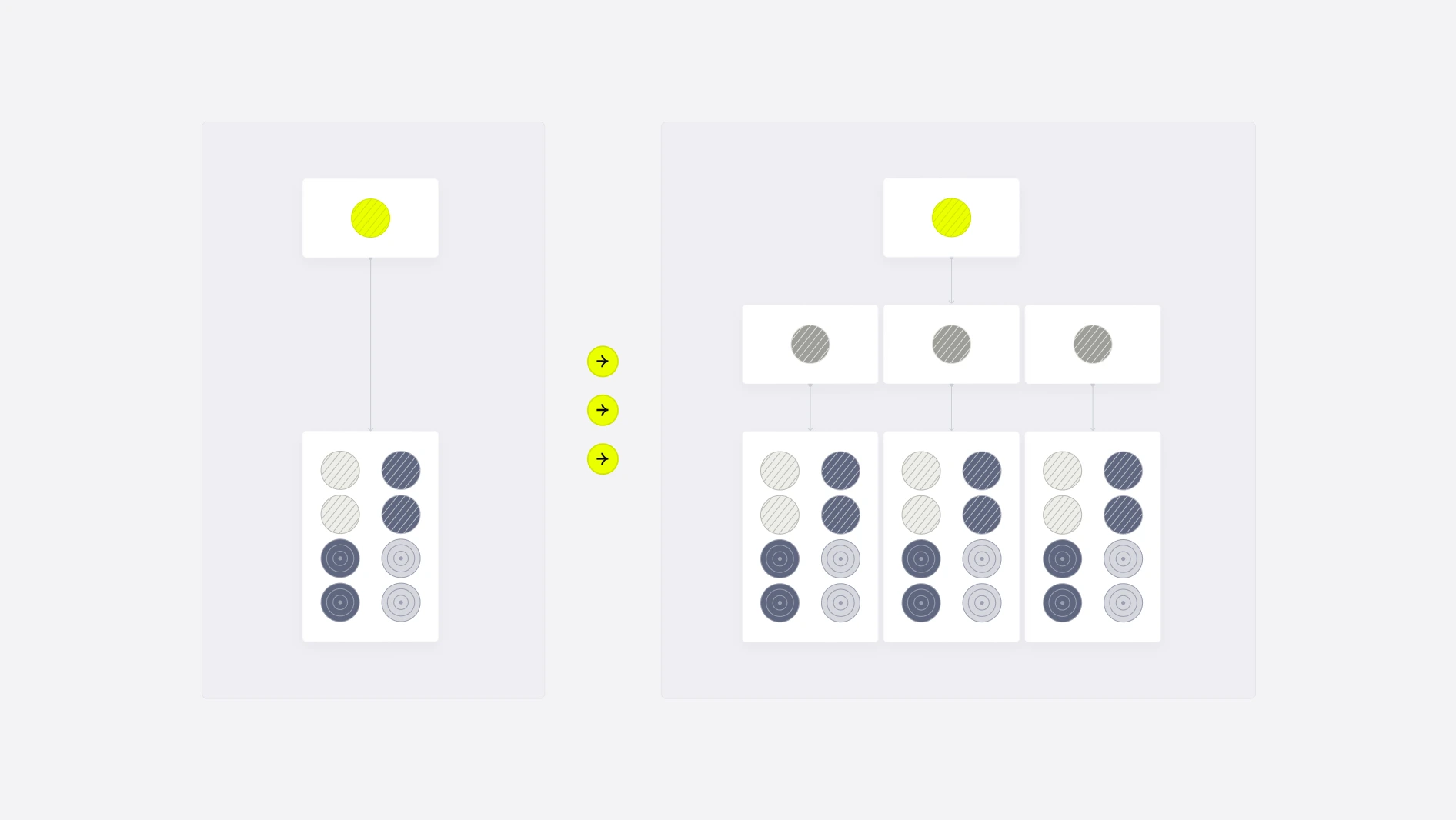
From Monoliths to Modular: How to Structure Engineering Teams as You Scale
July 23, 2025
Scaling tech companies often hit bottlenecks as old engineering structures slow progress. This guide covers when to restructure, proven team models, and key principles to scale effectively.

A Practical Guide to Building Agentic AI Products
January 9, 2025
Agentic AI systems transform workflows by using specialized agents to achieve customized, efficient, and scalable solutions. At OAK'S LAB, we design these systems to help businesses adapt and thrive in an AI-driven world.

Building AI-Powered Products Without ML Teams
October 15, 2024
Learn how to build AI-powered products without a dedicated machine learning team. This article outlines practical steps for integrating AI using pre-built models, improving your product's personalization, automation, and efficiency with minimal investment.

The OAK’S LAB WAY: An Introduction to Our Product Development Methodology
January 23, 2023
Our product development methodology designed to take an early-stage startup from pre-seed to series A and beyond.

How to Set Your Startup’s Mission & Vision
March 14, 2023
The twin north stars navigating startup founders and our teams on the journey to build a product that makes a big impact in the world.

Building Products with LLMs | 7 Tips for Success
August 1, 2023
Over the last few months, we’ve been fortunate enough to work with some startups that have LLM-driven products. Here are the best practices that we’ve learned along the way.

The Ultimate 7-Slide Formula for a Winning Startup Pitch Deck
May 24, 2023
Securing a seed investment is great validation and a big boost for early-stage startups; however, for first-time founders navigating the venture capital world isn’t easy. A well-crafted pitch deck can open investor doors and become the starting point from which an investment is made.