AI-native software development, built on context and accountability.
AI in Software Development
Context is the operating system
that underpins everything.
Bottlenecks in software delivery were never about typing speed, but in specifications.
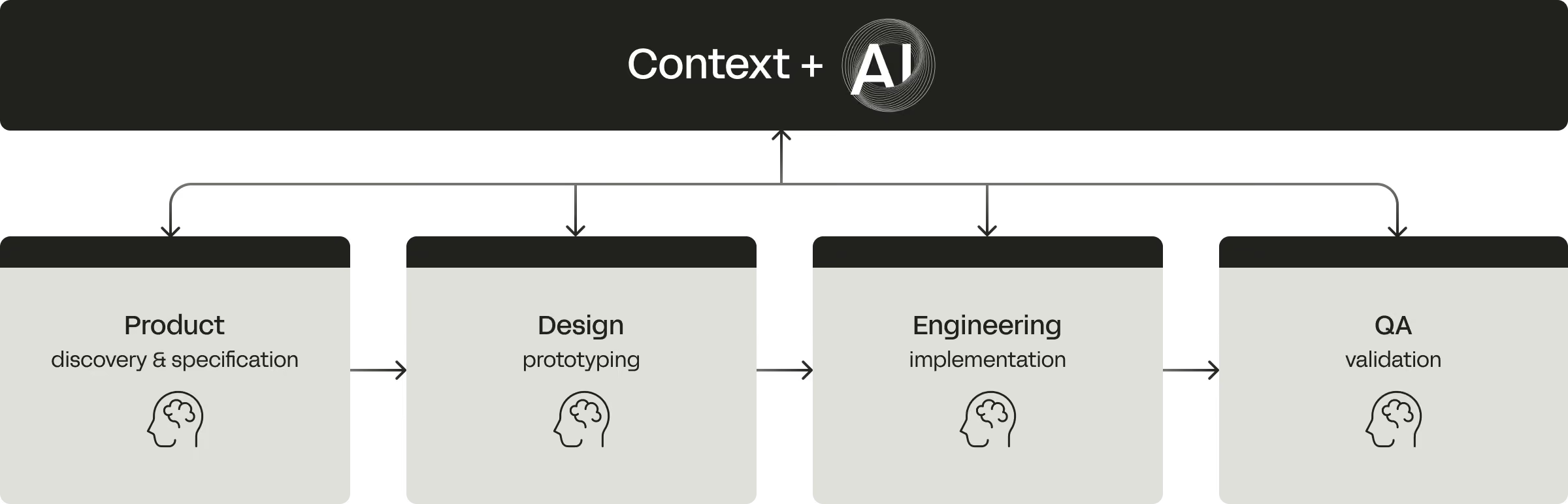
AI produces good work when it has accurate, current and shared context. That’s why we treat context management as foundational, not a by-product of meetings or documentation.
Product discovery, design decisions, implementation, and QA all run on the same continuously updated understanding. This keeps alignment intact, even as speed increases and scope changes.
Our Approach
How AI-native delivery actually works.
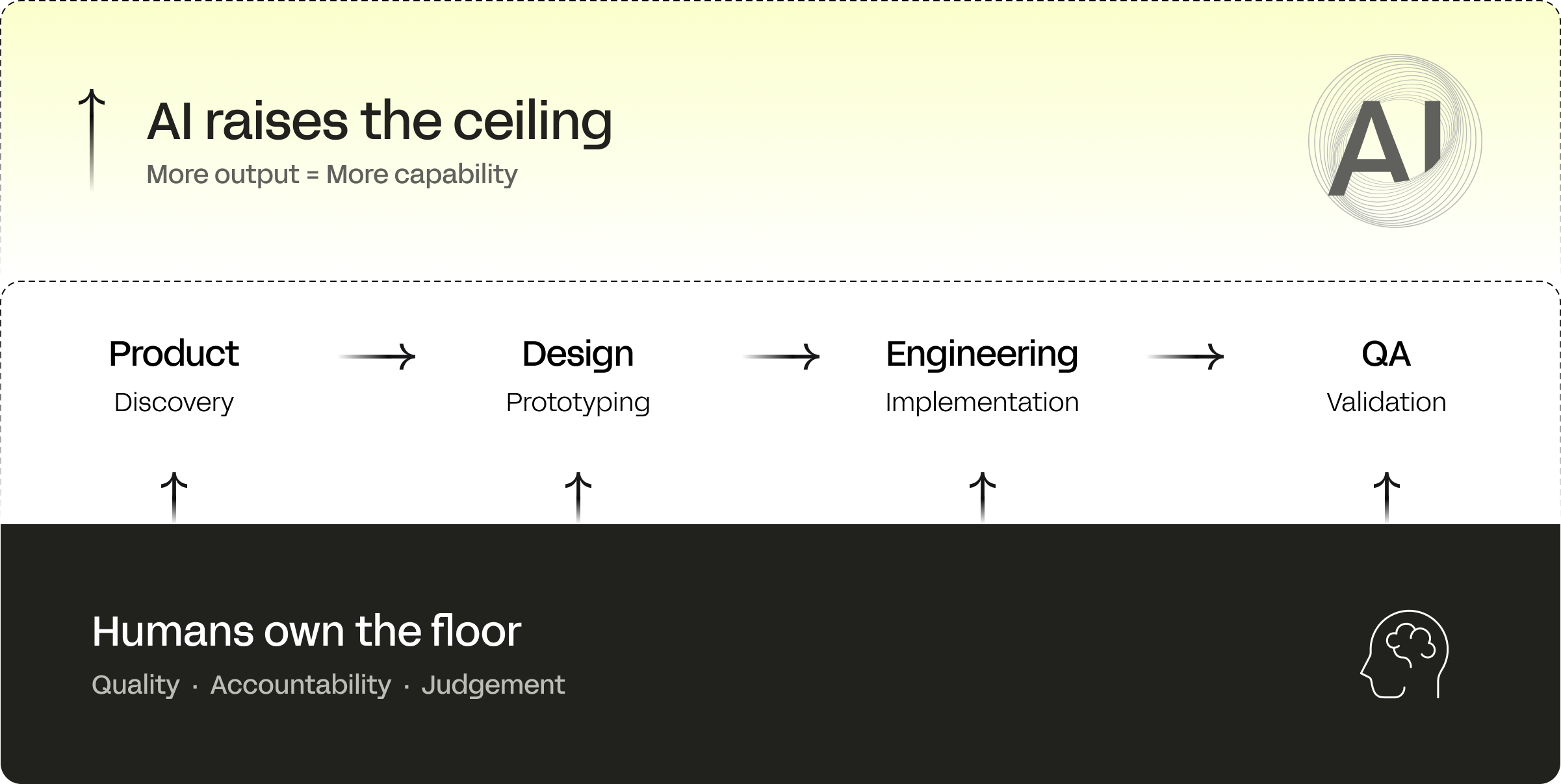
AI raises the ceiling on what teams can produce, but humans still own the floor. Our process is designed so context compounds, quality stays consistent, and accountability never transfers to a model.
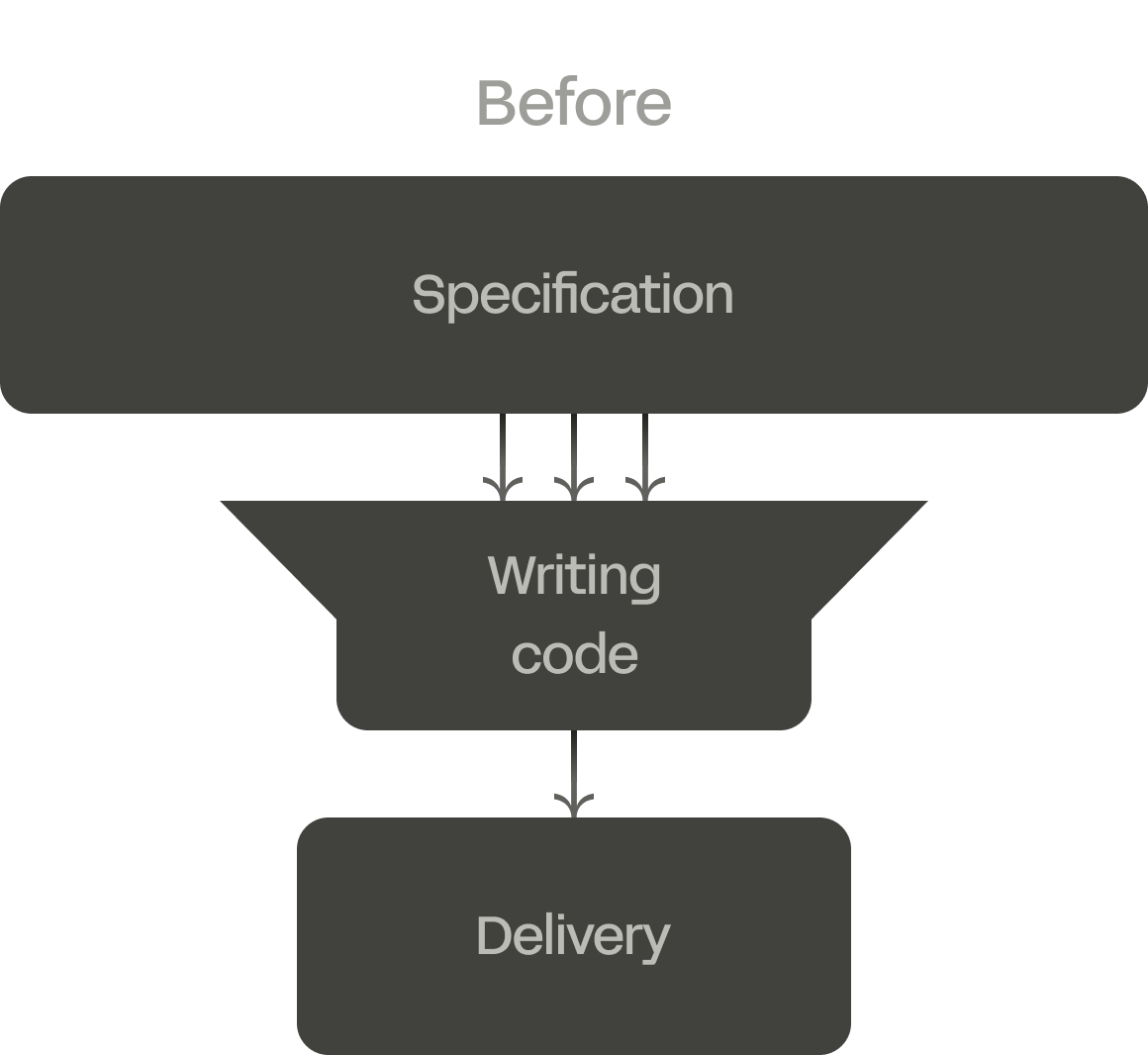
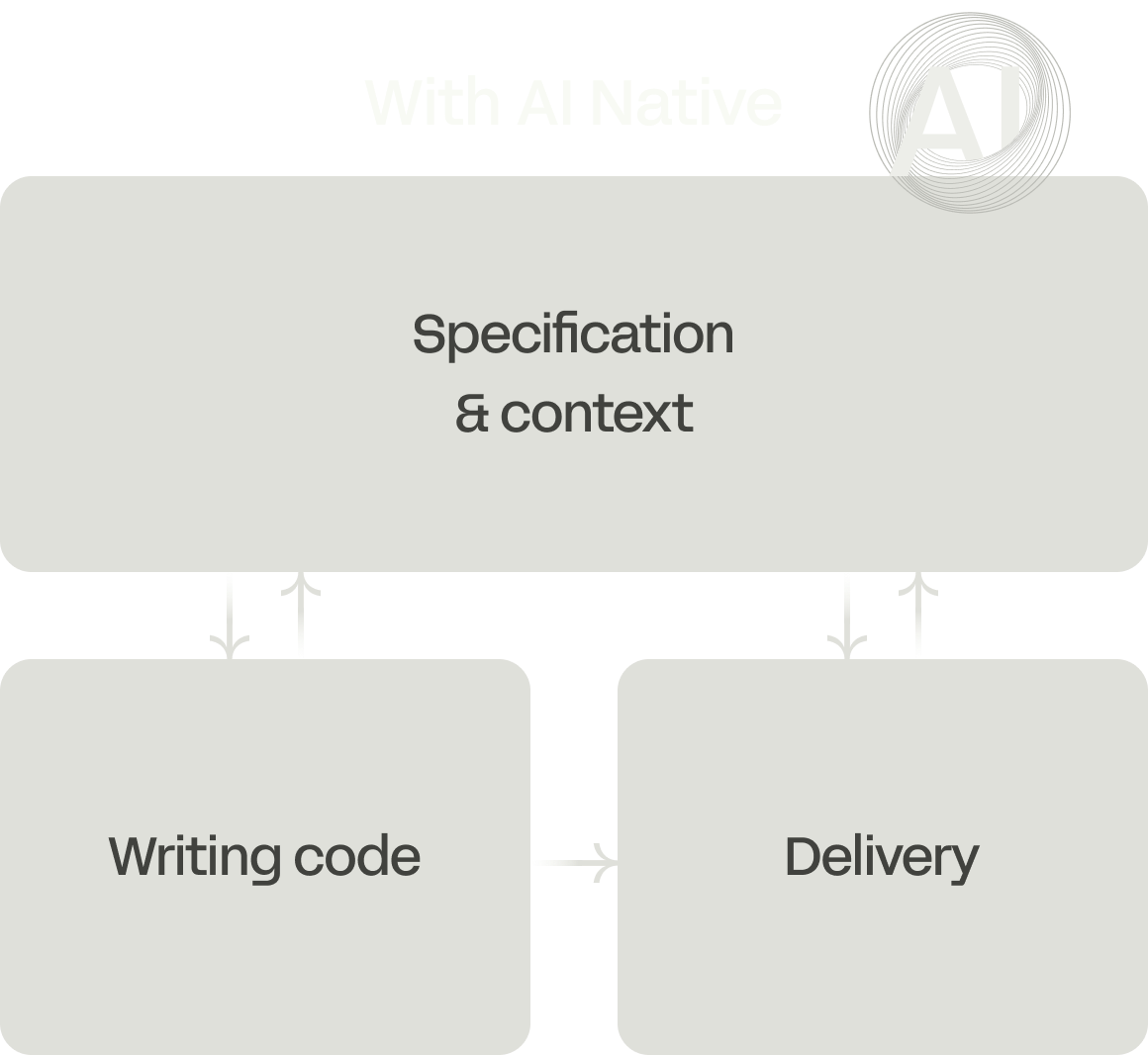
Context capture and management
We maintain a living, markdown-native knowledge system that is owned by the delivery team. AI works from this source of truth, but humans decide what belongs in it.
Product discovery and specifications
We write specifications to be built against, not interpreted later. This is where speed is either unlocked or lost.
Design and prototyping
AI helps us explore variations and edge cases, but designers and product leads decide what ships.
Engineering and implementation
All code is reviewed against explicit standards, and nothing is merged without human sign-off.
QA and validation
Every release decision, however big or small, remains human, documented, and accountable.

Fast is easy. Reliable is not.
Many AI-augmented teams move quickly until context drifts, quality blurs, or responsibility becomes unclear.
Our system is designed to prevent that. We maintain clear shared context and own decisions end to end, keeping quality gates explicit throughout. This allows us to move fast without sacrificing rigor.
Work
What this looks like in practice.
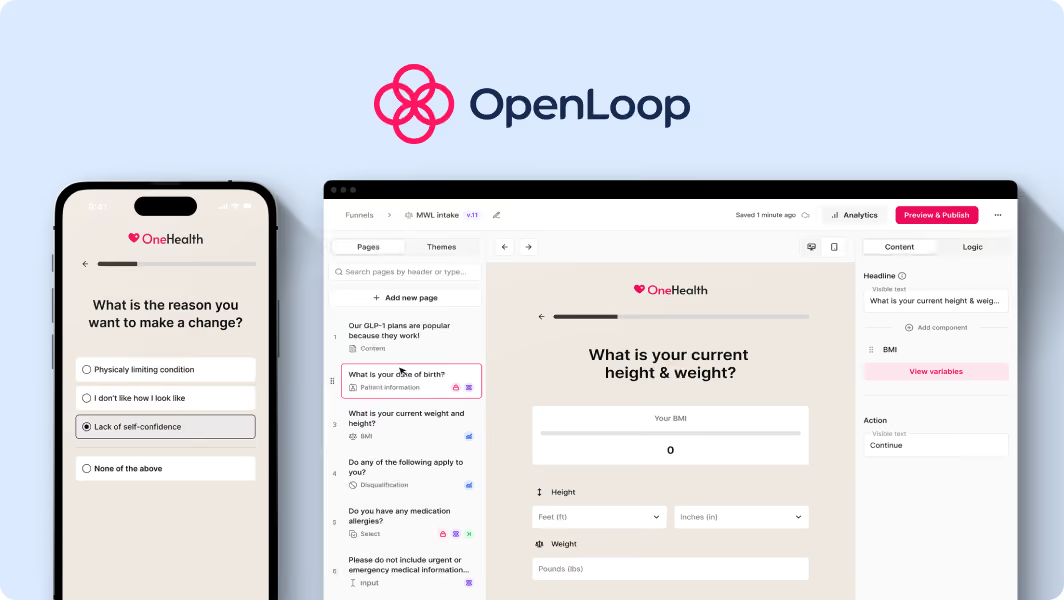
AI-native delivery only matters if it produces real outcomes under real constraints. Here are two recent examples of where context made the difference.
HealthTech / Virtual Care
Series A
OpenLoop Health
.avif)
Retail Technology
Series C
Swiftly
Reducing Risk
Accountability never transfers to the model.
AI changes how work gets done, but responsibility for outcomes never changes. We own decisions around scope, quality, security, and release at every step.
Security and data protection
We operate under a formal information security framework, including ISO 27001-certified processes.
AI tools are approved through a defined review process. Context systems are owned, controlled, and scoped per project. And sensitive data is handled according to client requirements, never exposed to unapproved third-party systems.

Quality and “AI slop”
The real risk with AI is low-quality output moving too fast to be questioned.
We operate with zero tolerance for that. We keep quality gates explicit, reviews mandatory, and delivery teams accountable at every stage. AI output is always treated as draft material until validated by experienced practitioners.
Our AI-Augmented Team
AI amplifies strong teams, it doesn’t replace them.
The biggest misconception is that AI flattens skill differences. In practice, it does the opposite.
Strong engineers, designers, and product leads become significantly more effective with AI, while weak foundations and unclear thinking are exposed faster.
That’s why our hiring bar hasn’t changed, even as AI has become core to how we deliver. We build teams where expertise compounds through shared context, reusable patterns, and senior review loops.
Technology
The stack behind AI-native development.
Languages & frameworks

.png)


AI we build into products


Data & storage


AI in how we deliver
Every tool in our stack is connected through MCP, so our AI works from live project context, not guesswork. The advantage isn't access to the tools, everyone has that. It's the workflows we've built to use them well.
Models & gateway:


Documentation:

Supporting tools:


DevOps & infrastructure


Security & compliance


Fast is easy. Reliable is not.
Many AI-augmented teams move quickly until context drifts, quality blurs, or responsibility becomes unclear.
Our system is designed to prevent that. We maintain clear shared context and own decisions end to end, keeping quality gates explicit throughout. This allows us to move fast without sacrificing rigor.
AI in Practice
Success with AI depends on process more than prompts.
Most teams underestimate the work required to use AI well, because the tools are easy to access. But AI is only ever as effective as the context, constraints, and judgment wrapped around it.
When used properly, the gains are real and durable. The ability to repeat those results, however, comes from process, discipline, and experience, not prompts alone.